Again the next day John was standing with two of his disciples, 36 and he looked at Jesus as He walked, and said, “Behold, the Lamb of God!” 37 And the two disciples heard him speak, and they followed Jesus. 38 And Jesus turned and saw them following, and said to them, “What are you seeking?” They said to Him, “Rabbi (which translated means Teacher), where are You staying?” 39 He said to them, “Come, and you will see.” So they came and saw where He was staying, and they stayed with Him that day; it was about the tenth hour. 40 One of the two who heard John speak, and followed Him, was Andrew, Simon Peter’s brother. 41 He first found his own brother Simon and said to him, “We have found the Messiah” (which translated means Christ). 42 He brought him to Jesus. Jesus looked at him and said, “You are Simon the son of John; you shall be called Cephas” (which is translated ]Peter).
Moving on in the narrative, we now begin to transition away from John the Baptist. The key things to know about him were that he was the one chosen by God to prepare the arrival of Jesus, he was a crucial witness to Jesus’ Godhood, and the last post showed how the Trinity is clearly understood from John’s act of baptism. I cannot think of any occasion in the Old Testament where the triune nature of God is on such an obvious display.
V35-37 – Again the next day John was standing with two of his disciples, and he looked at Jesus as He walked, and said, “Behold, the Lamb of God” And the two disciples heard him speak, and they followed Jesus.
Starting with these verses, John is once again out and about. John had his own disciples. There were people who followed his teaching and maybe even joined in on the work of baptism for repentance. The important thing to know is that John the Baptist deflects attention off himself to Jesus. He once again tells others that Jesus is the Lamb of God. If you do not understand this title, then please go to the previous post. There I mention briefly that this is a reference to Passover. John was one who knew his place in relation to Jesus. John was not an attention seeker. This is certainly an example for us to follow! How many times have we sought attention for ourselves when all praise is due to God! May we learn to deflect on to God the praise given to us!
Next, it’s remarkable that the two disciples to whom John was speaking were quick to follow Jesus. They didn’t need hours of conversation to convince them. They didn’t need a list of proofs. They probably were very familiar with John’s character since they were his disciples and so trusted his judgment on the matter. We know from the passage that one of the disciples is Andrew, but we know from Matthew, Mark and Luke that other disciples were also quick to follow Jesus. The point I’m making is that they trusted. I think that, in general, our American society has become less and less trusting. We doubt people who knock on our doors, we doubt sometimes unknown phone numbers, we doubt strangers outside as if everyone were a threat, we doubt the intentions of ministers, we doubt acts of kindness, and so on. I’m not saying that we shouldn’t be wise in how we interact with others, but I’ve observed overall that we as a people are not very trusting. And sadly, this same level of mistrust has extended to God and anything associated with him. It’s as if we think we can’t rely on the one who made us. We can’t rely on the one who holds our lives in our hands and gives us each breath and heartbeat. I’ve known several individuals who simply cannot believe that God would forgive anyone of their sins…such a God would be too good to be true and certainly not trustworthy in their estimation. Many Americans mistrust the Church, God’s people….”they all seem to be hypocrites and do the opposite of what they say”. I’m not excusing poor behavior, but people who claim such things fail to understand that they themselves are just as prone to error as we are. The difference is that we are aware of our need for help, whereas everyone outside the Church thinks they will be ok on their own. What we can learn from today’s passage, though, is that the disciples trusted Jesus even when they didn’t perfectly understand things. They were quick to follow him. May we learn to put aside our mistrust of everyone and everything, especially when dealing with God and his people!
V38-39 – And Jesus turned and saw them following, and said to them, “What are you seeking?” They said to Him, “Rabbi (which translated means Teacher), where are You staying?” He said to them, “Come, and you will see.” So they came and saw where He was staying, and they stayed with Him that day; it was about the tenth hour.
The two disciples approach Jesus after hearing John call him the Lamb of God. They obviously understood the Passover reference! And notice the funny question Jesus asks them…”what are you seeking?” He doesn’t start out by declaring himself to be the Messiah. He doesn’t start out by saying, “Yes indeed, I’m God in the flesh!” He wants to know what they seek. Do they want to know him because he is the Messiah, or do they have some other intention?
As we come to God, whether through prayer, his Word, a church service, etc… why do we come to him? Is it for just some quick benefit, some quick miracle, or is it because we know that he is extraordinary? Do we come to him because we know we desperately need him? And how do we approach him? Do we approach him as if he were just a fellow human? Do we approach him as if he were our pal? Or do we approach him with respect and fear? Those are a few questions to think about.
The two men want to know where Jesus is staying, presumably to talk to him and understand him. And notice how they took time to know him. I’m finding all sorts of applications in this passage today! We Americans are sometimes much too busy, and sometimes it’s a busy-ness that we impose upon ourselves. We don’t have to sign our kid up for 3 activities all at once, but we choose to because we feel we have to in order to be good parents or because everyone else does that. In some communities, we don’t have to have a full time job along with two side hustles, but we choose to because we want to buy a dream house or land. But again, these disciples set aside time for Jesus. They see his value. We tend to make time for what we see as valuable. If God means nothing to you, then of course you won’t make time for him. But to do so is a huge mistake. He who made you, doesn’t he deserve your time? He who blesses you with so many modern comforts, doesn’t he deserve your attention? He who gave his Son for you, doesn’t he deserve your worship? We steal and misuse time that God grants us when we choose to selfishly waste it on unimportant matters! In short, if you’re too busy for God, then you’re too busy, period!
V40-42 –One of the two who heard John speak, and followed Him, was Andrew, Simon Peter’s brother. He first found his own brother Simon and said to him, “We have found the Messiah” (which translated means Christ). He brought him to Jesus. Jesus looked at him and said, “You are Simon the son of John; you shall be called Cephas” (which is translated ]Peter).
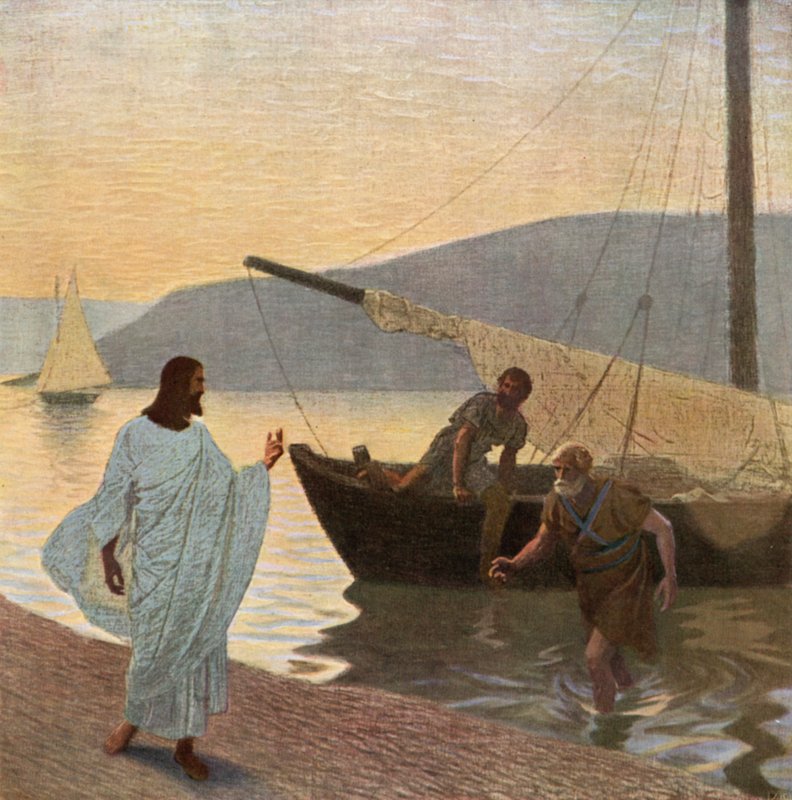
From these verses, we see that very early on Andrew was convinced of Jesus being the Messiah. Again, we see a huge level of trust! There was no wavering back and forth in Andrew! And not only does he believe as an individual, he then shares this revelation with his brother Simon. He doesn’t beat around the bush with Simon, he tells him directly that he has found the Messiah. He has met the one Israel (the world, really) has been waiting for. He has met the coming king of the world. So eventually, Peter comes to follow Jesus. In Matthew 4, it says that Peter was fishing when Jesus called him to follow. It could be that Peter was not as convinced as Andrew was at first, and that Jesus had to go out of his way to call Peter.
Everyone who is familiar with Peter knows he had his faults like all of us, but Jesus’ renaming him from Simon to Cephas/Peter was surely a fitting move. Peter or Cephas is translated as “rock”. Even though Peter was not as steady as he could’ve been (like a rock), he nevertheless in the book of Acts becomes one of the principal leaders of the early Church along with John and James. He also wrote two letters that are in the canon of the Bible, and was chosen by God on that day of Pentecost to proclaim who Jesus was. We sometimes hone in on Peter’s faults, but he was used by God in remarkable ways. And isn’t it wonderful to know that Jesus still chose to use him, even despite knowing his future mistakes? Isn’t it wonderful to know that God makes us and molds us into what we need to become? At the end of the Gospels, Peter denies Jesus. Then, in Acts 2, he is preaching to a large crowd of people after which 3,000 people convert to Christianity. Thank God that he doesn’t forget us by the wayside even though we all come to him full of mistakes!


Leave a Reply