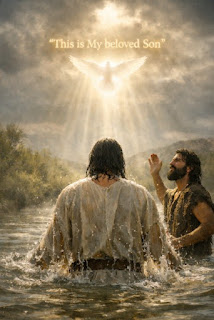
29 The next day he saw Jesus coming to him, and said, “Behold, the Lamb of God who takes away the sin of the world! 30 This is He in behalf of whom I said, ‘After me is coming a Man who has proved to be my superior, because He existed before me.’ 31 And I did not recognize [Him, but so that He would be revealed to Israel, I came baptizing in water.” 32 And John testified, saying, “I have seen the Spirit descending as a dove out of heaven, and He remained upon Him. 33 And I did not recognize Him, but He who sent me to baptize in water said to me, ‘He upon whom you see the Spirit descending and remaining upon Him, this is the One who baptizes in the Holy Spirit.’ 34 And I myself have seen, and have testified that this is the Son of God.”
Before commenting on these verses, I think that up until now it had been my tendency to rush over these verses due to familiarity. Now that I’m taking my time to go through this, there’s a lot of important stuff here! So that’s an encouragement to those of you who perhaps struggle with the Bible. Take your time with it. Don’t rush through your reading. Think about what it’s saying, look at what others have said about it, etc. A shallow reading of the Bible gives us a shallow understanding.
Also, there is much more I could say on this passage, but these are some initial thoughts.
V29 – The next day he saw Jesus coming to him, and said, “Behold, the Lamb of God who takes away the sin of the world!
John the Baptist is at work like usual, preaching and baptizing, and now he finally gets a full understanding that his relative Jesus is the Messiah. What John says here should not be overlooked. He says two very important things.
1) That Jesus is the Lamb of God
2) He is the lamb that takes away the sin of the world
Dealing with the first point, where does he come up with this title – the “Lamb of God”? This is probably a reference to Passover. If you are unfamiliar with Passover, it was a yearly celebration in Israel of when the Israelites left Egypt way back in the time of Moses in Exodus 12. Since it was done yearly, all Jewish people would be familiar with Passover and its meaning, just like every American is familiar with the 4th of July. The Israelites back then were told to kill a lamb and put its blood on the doorframes of their houses. The night of Passover, God sent an angel of death to kill the firstborn sons of any family that didn’t have blood on their doorframes. Only those who had applied the blood of a lamb would be spared. When you think of this event, let us not make the same mistake of rushing through it like everything else in the Bible. Passover was a terrifying, awful night! People were told that their firstborn son would die if they didn’t follow God’s instructions! And indeed it was a terrible night because Exodus 12:29-30 says, “At midnight the Lord struck down all the firstborn in Egypt, from the firstborn of Pharaoh, who sat on the throne, to the firstborn of the prisoner, who was in the dungeon, and the firstborn of all the livestock as well. Pharaoh and all his officials and all the Egyptians got up during the night, and there was loud wailing in Egypt, for there was not a house without someone dead.” Imagine the mass wailing and hysteria of that night! Imagine the anguish and confusion! When considering the awfulness of this event, we need to remember that the Pharoah (the leader) of Egypt had previously ordered that midwives kill all male babies born to Israelites, and the Egyptians also mistreated them through work. God was conveying the message that you can’t mess with his people without expecting him to rise to their defense! But anyway, the Passover lamb that was killed was supposed to foreshadow what the Lamb of God would eventually do. Jesus would one day shed his blood, and all who apply his blood to their lives will be spared from God’s anger against sin.
As for the second point, remember that the Passover lamb was only applied to Israelites. John points to the universality of Jesus’ shed blood. His blood was shed not just for Israelites, but for anyone across the globe who would come to him by faith! God’s people is no longer just the nation of Israel. Now, anyone from anywhere can join themselves to God!
V30-31 – This is He in behalf of whom I said, ‘After me is coming a Man who has proved to be my superior, because He existed before me.’ 31 And I did not recognize [Him, but so that He would be revealed to Israel, I came baptizing in water.”
So Jesus is not only the Lamb of God, the sacrifice given in our place, but he is also the pre-existent one. John says that Jesus existed before him. How is that possible? We once again have come to a statement proving Jesus’ eternality and Godhood. In John 1:1 it says Jesus, the Word, is God and was with God since the beginning. The only pre-existent one is God himself. Nowhere in the Bible does it say that ordinary humans have a preexistence somewhere. In the early church a man named Origen taught that humans have pre-existent souls, and in modern times the Mormons teach this as well…but this is nowhere seen in the Bible. John is hinting at Jesus’ eternality and Godhood by saying he came before him.
Verse 31 is somewhat puzzling. John says he didn’t know or recognize Jesus. John and Jesus were relatives, so one would think they would have known each other well. We must remember that John and Jesus didn’t grow up together. They didn’t live near one another. They may have occasionally seen one another if the whole family got together for Passover in Jerusalem, as an example, but other than that they probably didn’t spend time together. Also, Jesus lived an ordinary life up until he began his ministry at age 30. John obviously knew his mission was to prepare the way for the Messiah (see the previous post), but he had no reason to expect that Jesus was the Messiah. But now things have changed. Through John’s ministry of baptism, he came to understand and tell others that this Jesus of Nazareth is the Messiah of the world!
V32-34 – And John testified, saying, “I have seen the Spirit descending as a dove out of heaven, and He remained upon Him. And I did not recognize Him, but He who sent me to baptize in water said to me, ‘He upon whom you see the Spirit descending and remaining upon Him, this is the One who baptizes in the Holy Spirit.’ And I myself have seen, and have testified that this is the Son of God.”
At Jesus’ baptism we see yet another strong reference to the Trinity. Aberrant groups such as the Jehovah’s Witnesses, the Mormons, and Oneness Pentecostals try to deny the Trinity, but John will not allow it! We have God the Son being baptized, and God the Spirit descends upon him. John doesn’t include this, but also at this moment Matthew 3:17, Mark 1:11, and Luke 3:22 say that God the Father spoke audibly from heaven! We have all three persons of the Trinity mentioned in this act of baptism. So clearly, this act carries a lot of significance. The questions that came up in my mind as I read this are why do all three persons of the Trinity show up in this act, and why was Jesus baptized?
Let’s start with the second question, “Why was Jesus baptized?” John the Baptist baptized people for the repentance of sins. People would confess their sins and then be immersed in water, which symbolized their cleansing from sin. However, we maintain that Jesus never sinned…so why be baptized? People have had different ideas to answer this. Sinclair Ferguson, along with others, have said that people symbolically left their sin in the water upon being immersed. So we have the perfect, righteous Jesus being immersed into this “sin-filled” water where he foreshadows the exchange about to take place. Jesus will take our sins upon himself, and we will be granted his righteousness. So just like in baptism where we leave sin behind in the water, we leave sin behind because they were placed on Jesus!
Another reason for his baptism was brought up one time while I was listening to the radio in my car. Priests would wash themselves before performing priestly duties. Likewise, Moses washed Aaron and his sons with water when being put into their priestly service in Leviticus 8:6. It could be that Jesus’ baptism was supposed to be his ordination as High Priest! Moreover, remember that John the Baptist was from the tribe of Levi. So we have here a Levite baptizing a person from the tribe of Judah into the priesthood. Perhaps this was a way of recognizing a change of priesthood, as explained in Hebrews 7:11-19. Jesus’ priesthood was not one where sacrifices had to be given over and over again. His priesthood entailed him giving himself once and for all!
Now that we have briefly answered that question, we can now answer the question, “Why do all three persons of the Trinity show up in the baptism?” Perhaps the best way to explain this is that this is God’s seal of approval on Jesus’ mission. This was God’s way of showing to others that Jesus was sent from the Father, and his ministry is empowered by the Holy Spirit. Jesus is not just an ordinary, average human. He is God in the flesh.
Another thought that came to mind is that by all three persons showing up, God is further revealing his triune nature now that Jesus has arrived. There was somewhat of an understanding of the Trinity in the Old Testament, but Jesus’ arrival clarified it. In the Old Testament, we have instances where people worship and give offerings to the “Angel of the Lord”, and other instances where the Spirit of the Lord descends upon people to empower them for certain works. However, we usually don’t read of the Father, the Angel of the Lord, and the Spirit working together all in the same passage. Here, though, in John we see all three persons working together at the start of God’s mission to rescue humanity!
A final thought on the Trinity in Jesus’ baptism is that in this passage Jesus is referred to as the one who baptizes with the Holy Spirit. We see in this what Jesus will eventually allow for all believers under the New Covenant. All believers will be empowered and filled with the Holy Spirit. It will no longer be like the Old Testament where the Spirit temporarily fills people for works. The Spirit will remain upon us. So Jesus’ baptism is also an example for us to follow and is a demonstration of what happens when we are adopted into the kingdom! We become God’s child, we become part of a royal priesthood, and we are empowered and filled with the Holy Spirit!
This passage is filled with so many good things…the fulfillment of the Passover Lamb in Jesus, the Trinity, the initiation of Jesus as High Priest, and the infilling of the Holy Spirit. This should all fill us with thankfulness and awe at what God has done through Jesus…and we’re still just at the beginning of John!
 Thinking Theo
Leave a comment