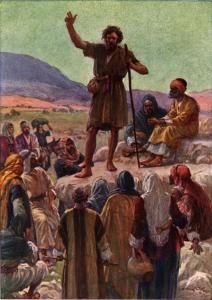
19 This is the testimony of John, when the Jews sent priests and Levites to him from Jerusalem to ask him, “Who are you?” 20 And he confessed and did not deny; and this is what he confessed: “I am not the [w]Christ.” 21 And so they asked him, “What then? Are you Elijah?” And he *said, “I am not.” “Are you the Prophet?” And he answered, “No.” 22 Then they said to him, “Who are you? Tell us, so that we may give an answer to those who sent us. What do you say about yourself?” 23 He said, “I am the voice of one calling [x]out in the wilderness, ‘Make the way of the Lord straight,’ as Isaiah the prophet said.”
24 And the messengers had been sent from the Pharisees. 25 They asked him, and said to him, “Why then are you baptizing, if you are not the [y]Christ, nor Elijah, nor the Prophet?” 26 John answered them, saying, “I baptize [z]in water, but among you stands One whom you do not know. 27 It is He who comes after me, of whom I am not worthy even to untie the strap of His sandal.” 28 These things took place in Bethany beyond the Jordan, where John was baptizing people.
Today’s post will cover more verses since the first 18 verses had a lot of content. We now will see that John switches a narrative style of writing.
This section for today explains the relation of John the Baptist to Jesus. John the Baptist gets a backseat to Jesus, but that backseat position is still very important. As seen in history, the person who gets the most credit and notoriety always has people coming before them (or accompanying them) that set them up to do great things. For example, Martin Luther could not have been as effective without forerunners like Jan Huss and John Wycliffe. RC Sproul would not have been such a well-known teacher and author without the influence of John Gerstner. John Macarthur would not have been what he was without the influence of his father. Martyn Lloyd Jones might not have become what he did without G Campbell Morgan coming before him. God has ordained that some people prepare the way for others, which is not something to be scoffed at. And such is the case with John the Baptist. Jesus is God, so he technically can do anything, but God ordained that John the Baptist would prepare the people of Israel for Jesus’ ministry.
Starting in verse 19, we know that John had a well-known baptism ministry. Mark 1:5 says that many of the people in the regions where he was baptizing went to him to be baptized or hear him speak. News of his message and baptism had reached the ears of Jews in Jerusalem. As such, the Pharisees want to find out who exactly John is. They ask him, “Who are you?” In other words, “Who do you claim to be?” This is a very important question. At this point, John could’ve claimed to be someone greater than he was. He apparently was a popular figure, and so here could have been his chance to get more fame. He is so popular that it almost seems like the messengers are expecting him to say that he is the Messiah! But in verse 20, he says plainly that he is not the Christ. He is not the Messiah. He is not the one Israel is waiting for to rescue them.
So he isn’t the Christ, but that leaves two other possibilities. They ask him if he is Elijah. Where is this coming from? Malachi 4:5 says that God will send Elijah before the day of reckoning. In other words, Elijah will come before God is about to do something big. However, John denies being Elijah. What is funny about denying that is that Jesus says in Matthew 17:12 that John was Elijah – not a reincarnation of Elijah – but he came in the “spirit” of Elijah. What I mean is that John came to do similar works that Elijah did. Elijah was known for his call to repentance, and John the Baptist played a similar role.
John is not Elijah, but that leaves the possibility that he might be the Prophet. What is meant by this? In Deuteronomy 18:15 Moses prophesies that a prophet like him will come and the people must listen to him. So this “prophet” will be like Moses. Most Christians believe that this particular prophet was Jesus, but the Jews didn’t know that at the time. Again, though, John denies that he is the Prophet.
In verse 22 we see that John’s denial of being the Christ, Elijah, or the Prophet confuse the messengers. In verse 23 he reveals his role. John is the fulfillment of Isaiah 40:3. Going back to Isaiah 40-66, this great section communicates the majesty, sovereignty, and consolation of God. Among other things, God declares that he will restore his people. In Isaiah 40 specifically, there is a part where Isaiah says someone will come to comfort God’s people. John the Baptist came to fulfill that role! He was born to declare God’s comfort to his people in that the Messiah had come! The world had been waiting the arrival of a redeemer, and John had the privilege of preparing God’s covenant people for it!
Going now to verses 24 to 28, the messengers are still confused as to why John baptizes people for repentance if he isn’t the Messiah, Elijah , or the Prophet. Speaking of baptism, this practice was not new to John. In the Old Testament there were instances where people would immerse themselves in water in a pool of water called a mikvah to symbolize cleansing. For example, men with a discharge in Leviticus 15:1-5, women after their periods in Leviticus 19-21, priests before beginning their duties in Leviticus 16:1-4, people after touching a dead animal in Leviticus 17:15, and anyone who touched a dead person in Numbers 19:11-12 had to be immersed in water (baptized) to either be declared clean or be set apart. As you can see, baptism was associated with being cleansed of something. The water itself did not cleanse you, but it was a visible portrayal of an invisible reality. Later on in the intertestamental period (the time between the Old and New Testament), baptism began to be associated more specifically with the forgiveness of sins. Jews also would baptize converts to Judaism, and the Essenes were known for baptizing individuals who wished to join their community and to be cleansed of sin. The Essenes were a group of Jews who lived out in wilderness areas and sort of lived like monks. Some think John may have been a part of this group and carried over their understanding of baptism.
Going back to John 1:24-28, the messengers and Pharisees would have been familiar with baptism and washing, so it was confusing to them why someone insignificant would be performing mass baptisms. And so John gives them the reason for it. He basically says that he is baptizing for repentance because someone has come who is far superior to all other humans. He is so superior, that John is not even worthy to untie his sandals. Once again, this has to do with John’ mission. He came to prepare people for Jesus. John came proclaiming repentance, and Jesus would preach the same message!
In conclusion, I think we can say two main things about this passage. One, we clearly see Jesus’ supremacy in this passage just like we did in 1:1-18. This is John’s main message. John the Baptist is seen as a great man, but John confesses that there is someone even greater coming! May we all emulate John’s proper positioning of himself in relation to Jesus! Secondly, we should not underestimate the importance of what some might call “lesser service” for God. John was not the Messiah and his work might not be seen as glamorously as that of Jesus and the apostles, but his work was extremely important nonetheless. There is great value in those who do legwork. Really, it should be said that ALL work done for the Lord is of great value!
 Thinking Theo
Leave a comment