Month: June 2026

  • Psalm 73:21-28

    21When my soul was embittered,
        when I was pricked in heart,
    22 I was brutish and ignorant;
        I was like a beast toward you.

    23 Nevertheless, I am continually with you;
        you hold my right hand.
    24 You guide me with your counsel,
        and afterward you will receive me to glory.
    25 Whom have I in heaven but you?
        And there is nothing on earth that I desire besides you.
    26 My flesh and my heart may fail,
        but God is the strength[b] of my heart and my portion forever.

    27 For behold, those who are far from you shall perish;
        you put an end to everyone who is unfaithful to you.
    28 But for me it is good to be near God;
        I have made the Lord God my refuge,
        that I may tell of all your works.

    Today I’m not going to write about John because of a crisis going on. I will not explain what it is about, but I thought of writing on one of my favorite Psalms – Psalm 73. This is mainly to help me as I write to focus my thoughts on God instead of the problems at hand, and I also pray this will be helpful to someone else.

    Psalm 73 was written by a man named Asaph. The whole idea of the psalm is that upon seeing the comfortable lives that evil people lead, he began to despair of his love for God. He says in verse 12 that the evil are always at ease and increase in riches. He says in verse 13 that he has kept his heart and hands clean in vain! How many times have we perhaps felt the same way? “God, why is this bad thing happening to me if I love you? God, what’s the point in serving you if I suffer?? God, you could’ve prevented all these bad things, so why haven’t you???” In times of weakness we can be tempted to think this way. In times of weakness, all sorts of thoughts can run through our heads that cause us to doubt God’s goodness and his plans. But the turnaround in Psalm 73 occurs in verse 17. There, Asaph goes to God’s sanctuary. It is there, in light of spending time with God, that Asaph understands the foolishness in thinking that serving God is of no use. I wonder if that’s the place we run to when we encounter doubts and trouble…or do we run elsewhere?

    In verse 21 until the end of the psalm, we see a big difference in Asaph’s thinking as compared to before.

    21When my soul was embittered,
        when I was pricked in heart,
    22 I was brutish and ignorant;
        I was like a beast toward you.

    Asaph confesses his foolishness and error in thinking that loving God is without purpose. He humbles himself here. He says he was like an animal in his thinking – meaning without understanding. May we copy his humility when we begin to think wrongly of God and the purpose of loving him!

    23 Nevertheless, I am continually with you;
        you hold my right hand.
    24 You guide me with your counsel,
        and afterward you will receive me to glory.
    25 Whom have I in heaven but you?
        And there is nothing on earth that I desire besides you.

    Isn’t it wonderful to know that God doesn’t cut us off even after mistakes (verse 23)? Asaph, despite his previous doubts, affirms that he still walks with God. This is one of the best aspects of the book of Psalms. Some start out with the writer in agony, despair, or depression, but we repeatedly see the same pattern of joy coming when the writer refocuses themself on God! God holds Asaph’s right hand. That is, God is guiding Asaph. He hasn’t let him go. Like a parent who holds their toddler as they walk down a busy street with them, so God continually guides us by the hand. God won’t lose his children. John 6:39 – “And this is the will of him who sent me, that I shall lose none of all those he has given me, but raise them up at the last day.” Jesus declares that he won’t lose those that have come to him in faith and have been born-again by his Holy Spirit.

    And as for you, remember that God won’t lose you, he won’t leave you, even despite your many mistakes. If you belong to him, he has your hand. He is continually with you.

    Verse 24 is a verse of assurance. There is no doubt in Asaph’s mind that God will guide him every day until one day God receives him in glory. God will guide Asaph until one day he gets to be with him in his presence. The same is true for every believer. God will guide us every step of the way until we’re with him. 1 Thessalonians 4:17 – “…and so we shall ever be with the Lord.” Heaven is just that – being with God. Enjoying God. As the Westminster Confession of Faith says, the chief end of man is to glorify God and enjoy him forever.

    Verse 25 is one of my most favorite verses in the Bible. Here we see an expression of Asaph’s love for God. I think it’s near impossible to not see the parent-child imagery in Psalm 73. God holds Asaph’s hand, he guides him along, and he will bring him into his presence. And this love that God has for Asaph is reciprocated by Asaph. Asaph loves God. May all of us give back to God the great love he has shown to us.

    “Whom have I in heaven but you?” No angel, passed away loved ones, or well-known believers of the past would satisfy Asaph’s desire. Asaph’s primary longing was for God himself.

    “And there is nothing on earth that I desire besides you.” Nothing in heaven or on earth was more desirable to Asaph than God. What about for people of our age? Today, we have a lot more options to choose from to entertain us in this life. Compared to Asaph’s day and age we have movies, tv shows, more sports, casinos, bars, nightclubs, Youtube, etc. Maybe Asaph just desired God because he had less distractions to choose from. But this isn’t so. For a true believer, God will always be preferrable to anything else in heaven or on earth. A man or woman whose heart has been captured by God will always long for him above everything else.

    26 My flesh and my heart may fail,
        but God is the strength[b] of my heart and my portion forever.

    Next is verse 26. He basically says that my body and mind may get weak, but God is my strength. Our bodies and minds can become weak at any age. Sometimes we weaken due to aging, other times it may be due to sickness or excessive stress. Sometimes we may hold out longer than others in strength, but eventually all of us weaken over time. We all share this common end. But remember this…God is our strength. Your body may be weak, but God never weakens. His strength never decreases! And not only that, he is our “portion” forever. He is ours. We belong to him, and he to us.

    27 For behold, those who are far from you shall perish;
        you put an end to everyone who is unfaithful to you.
    28 But for me it is good to be near God;
        I have made the Lord God my refuge,
        that I may tell of all your works.

    Here we see in verse 27 the lot of those who reject God. They will perish, they will be condemned…and rightfully so. We have no right to reject the one who gives us life and breath. When we reject God, we reject all that is good. But then we get to verse 28. We should all remember this… it is good to be near God. We may feel far from him in times of trouble, but let’s draw near to him. Lay aside your distractions and doubts. We may feel far from him, but remember above Asaph’s words – he is continually with us. And we see in the next phrase what Asaph means by being near God. God is Asaph’s refuge. God is the person Asaph goes to in trouble. But it’s more than that. The world in general can be a sad place, so we need a place where we can dwell to shelter ourselves from that. The picture that comes to my mind is like a person who has been lost somewhere outside for a long time in a constant storm. He is tired of the constant rain, wind and thunder. He then one day finds a safe cave to stay in to get away from this constant rain. He then realizes he will make the cave his new home because it’s not good to sleep outside and roam around all day in a storm. This is what God should be like to us. We all roam around in this world of sin and sadness. Sometimes we cause the sin and sadness, and sometimes they come about from things beyond our control. Where will we dwell? Will we continue to roam about in this sin-filled world where things like greed, theft, murder, addictions, jealousy, anger, lust, deceit, etc are the constant norm? Or will we run to this cave that we can finally call home?

    As I finish, remember to refocus your thoughts on God when troubles come. Remember that even despite current difficulties, God is our strength. He is our portion. It is good to be near to God. He should be our highest desire. I’ve gotten to liking a number of hymns as I’ve gotten older. One that I’m always reminded of is where the chorus says, “Turn your eyes upon Jesus, look full in his wonderful face. And the things of earth will grow strangely dim in the light of his glory and grace.” That’s what Asaph did. He got his eyes off of the Lord, and things began to look very bad. Once he got his eyes back on his savior, he remembered how good God is. He remembered who he can run to.
  • John 1:35-42

    Again the next day John was standing with two of his disciples, 36 and he looked at Jesus as He walked, and said, “Behold, the Lamb of God!” 37 And the two disciples heard him speak, and they followed Jesus. 38 And Jesus turned and saw them following, and said to them, “What are you seeking?” They said to Him, “Rabbi (which translated means Teacher), where are You staying?” 39 He said to them, “Come, and you will see.” So they came and saw where He was staying, and they stayed with Him that day; it was about the tenth hour. 40 One of the two who heard John speak, and followed Him, was Andrew, Simon Peter’s brother. 41 He first found his own brother Simon and said to him, “We have found the Messiah” (which translated means Christ). 42 He brought him to Jesus. Jesus looked at him and said, “You are Simon the son of John; you shall be called Cephas” (which is translated ]Peter).

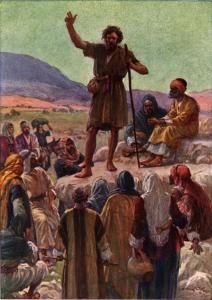
    Moving on in the narrative, we now begin to transition away from John the Baptist. The key things to know about him were that he was the one chosen by God to prepare the arrival of Jesus, he was a crucial witness to Jesus’ Godhood, and the last post showed how the Trinity is clearly understood from John’s act of baptism. I cannot think of any occasion in the Old Testament where the triune nature of God is on such an obvious display.

    V35-37 – Again the next day John was standing with two of his disciples, and he looked at Jesus as He walked, and said, “Behold, the Lamb of God” And the two disciples heard him speak, and they followed Jesus. 

     Starting with these verses, John is once again out and about. John had his own disciples. There were people who followed his teaching and maybe even joined in on the work of baptism for repentance. The important thing to know is that John the Baptist deflects attention off himself to Jesus. He once again tells others that Jesus is the Lamb of God. If you do not understand this title, then please go to the previous post. There I mention briefly that this is a reference to Passover. John was one who knew his place in relation to Jesus. John was not an attention seeker. This is certainly an example for us to follow! How many times have we sought attention for ourselves when all praise is due to God! May we learn to deflect on to God the praise given to us!

    Next, it’s remarkable that the two disciples to whom John was speaking were quick to follow Jesus. They didn’t need hours of conversation to convince them. They didn’t need a list of proofs. They probably were very familiar with John’s character since they were his disciples and so trusted his judgment on the matter. We know from the passage that one of the disciples is Andrew, but we know from Matthew, Mark and Luke that other disciples were also quick to follow Jesus. The point I’m making is that they trusted. I think that, in general, our American society has become less and less trusting. We doubt people who knock on our doors, we doubt sometimes unknown phone numbers, we doubt strangers outside as if everyone were a threat, we doubt the intentions of ministers, we doubt acts of kindness, and so on. I’m not saying that we shouldn’t be wise in how we interact with others, but I’ve observed overall that we as a people are not very trusting. And sadly, this same level of mistrust has extended to God and anything associated with him. It’s as if we think we can’t rely on the one who made us. We can’t rely on the one who holds our lives in our hands and gives us each breath and heartbeat. I’ve known several individuals who simply cannot believe that God would forgive anyone of their sins…such a God would be too good to be true and certainly not trustworthy in their estimation. Many Americans mistrust the Church, God’s people….”they all seem to be hypocrites and do the opposite of what they say”. I’m not excusing poor behavior, but people who claim such things fail to understand that they themselves are just as prone to error as we are. The difference is that we are aware of our need for help, whereas everyone outside the Church thinks they will be ok on their own. What we can learn from today’s passage, though, is that the disciples trusted Jesus even when they didn’t perfectly understand things. They were quick to follow him. May we learn to put aside our mistrust of everyone and everything, especially when dealing with God and his people!

    V38-39 – And Jesus turned and saw them following, and said to them, “What are you seeking?” They said to Him, “Rabbi (which translated means Teacher), where are You staying?” He said to them, “Come, and you will see.” So they came and saw where He was staying, and they stayed with Him that day; it was about the tenth hour. 

    The two disciples approach Jesus after hearing John call him the Lamb of God. They obviously understood the Passover reference! And notice the funny question Jesus asks them…”what are you seeking?” He doesn’t start out by declaring himself to be the Messiah. He doesn’t start out by saying, “Yes indeed, I’m God in the flesh!” He wants to know what they seek. Do they want to know him because he is the Messiah, or do they have some other intention?

    As we come to God, whether through prayer, his Word, a church service, etc… why do we come to him? Is it for just some quick benefit, some quick miracle, or is it because we know that he is extraordinary? Do we come to him because we know we desperately need him? And how do we approach him? Do we approach him as if he were just a fellow human? Do we approach him as if he were our pal? Or do we approach him with respect and fear? Those are a few questions to think about.

    The two men want to know where Jesus is staying, presumably to talk to him and understand him. And notice how they took time to know him. I’m finding all sorts of applications in this passage today! We Americans are sometimes much too busy, and sometimes it’s a busy-ness that we impose upon ourselves. We don’t have to sign our kid up for 3 activities all at once, but we choose to because we feel we have to in order to be good parents or because everyone else does that. In some communities, we don’t have to have a full time job along with two side hustles, but we choose to because we want to buy a dream house or land. But again, these disciples set aside time for Jesus. They see his value. We tend to make time for what we see as valuable. If God means nothing to you, then of course you won’t make time for him. But to do so is a huge mistake. He who made you, doesn’t he deserve your time? He who blesses you with so many modern comforts, doesn’t he deserve your attention? He who gave his Son for you, doesn’t he deserve your worship? We steal and misuse time that God grants us when we choose to selfishly waste it on unimportant matters! In short, if you’re too busy for God, then you’re too busy, period!

    V40-42 –One of the two who heard John speak, and followed Him, was Andrew, Simon Peter’s brother. He first found his own brother Simon and said to him, “We have found the Messiah” (which translated means Christ). He brought him to Jesus. Jesus looked at him and said, “You are Simon the son of John; you shall be called Cephas” (which is translated ]Peter).

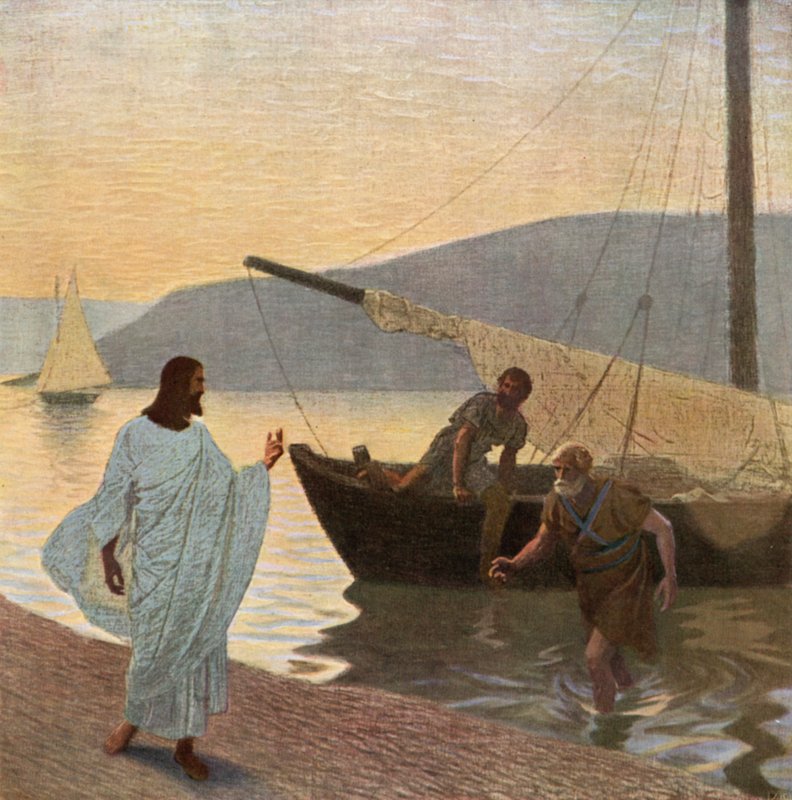
    From these verses, we see that very early on Andrew was convinced of Jesus being the Messiah. Again, we see a huge level of trust! There was no wavering back and forth in Andrew! And not only does he believe as an individual, he then shares this revelation with his brother Simon. He doesn’t beat around the bush with Simon, he tells him directly that he has found the Messiah. He has met the one Israel (the world, really) has been waiting for. He has met the coming king of the world. So eventually, Peter comes to follow Jesus. In Matthew 4, it says that Peter was fishing when Jesus called him to follow. It could be that Peter was not as convinced as Andrew was at first, and that Jesus had to go out of his way to call Peter.

    Everyone who is familiar with Peter knows he had his faults like all of us, but Jesus’ renaming him from Simon to Cephas/Peter was surely a fitting move. Peter or Cephas is translated as “rock”. Even though Peter was not as steady as he could’ve been (like a rock), he nevertheless in the book of Acts becomes one of the principal leaders of the early Church along with John and James. He also wrote two letters that are in the canon of the Bible, and was chosen by God on that day of Pentecost to proclaim who Jesus was. We sometimes hone in on Peter’s faults, but he was used by God in remarkable ways. And isn’t it wonderful to know that Jesus still chose to use him, even despite knowing his future mistakes? Isn’t it wonderful to know that God makes us and molds us into what we need to become? At the end of the Gospels, Peter denies Jesus. Then, in Acts 2, he is preaching to a large crowd of people after which 3,000 people convert to Christianity. Thank God that he doesn’t forget us by the wayside even though we all come to him full of mistakes!

  • John 1:29-34

    29 The next day he saw Jesus coming to him, and said, “Behold, the Lamb of God who takes away the sin of the world! 30 This is He in behalf of whom I said, ‘After me is coming a Man who has proved to be my superior, because He existed before me.’ 31 And I did not recognize [Him, but so that He would be revealed to Israel, I came baptizing in water.” 32 And John testified, saying, “I have seen the Spirit descending as a dove out of heaven, and He remained upon Him. 33 And I did not recognize Him, but He who sent me to baptize in water said to me, ‘He upon whom you see the Spirit descending and remaining upon Him, this is the One who baptizes in the Holy Spirit.’ 34 And I myself have seen, and have testified that this is the Son of God.”

    Before commenting on these verses, I think that up until now it had been my tendency to rush over these verses due to familiarity. Now that I’m taking my time to go through this, there’s a lot of important stuff here! So that’s an encouragement to those of you who perhaps struggle with the Bible. Take your time with it. Don’t rush through your reading. Think about what it’s saying, look at what others have said about it, etc. A shallow reading of the Bible gives us a shallow understanding.

    Also, there is much more I could say on this passage, but these are some initial thoughts.

    V29 – The next day he saw Jesus coming to him, and said, “Behold, the Lamb of God who takes away the sin of the world! 

    John the Baptist is at work like usual, preaching and baptizing, and now he finally gets a full understanding that his relative Jesus is the Messiah. What John says here should not be overlooked. He says two very important things.

    1) That Jesus is the Lamb of God

    2) He is the lamb that takes away the sin of the world

    Dealing with the first point, where does he come up with this title – the “Lamb of God”? This is probably a reference to Passover. If you are unfamiliar with Passover, it was a yearly celebration in Israel of when the Israelites left Egypt way back in the time of Moses in Exodus 12. Since it was done yearly, all Jewish people would be familiar with Passover and its meaning, just like every American is familiar with the 4th of July. The Israelites back then were told to kill a lamb and put its blood on the doorframes of their houses. The night of Passover, God sent an angel of death to kill the firstborn sons of any family that didn’t have blood on their doorframes. Only those who had applied the blood of a lamb would be spared. When you think of this event, let us not make the same mistake of rushing through it like everything else in the Bible. Passover was a terrifying, awful night! People were told that their firstborn son would die if they didn’t follow God’s instructions! And indeed it was a terrible night because Exodus 12:29-30 says, “At midnight the Lord struck down all the firstborn in Egypt, from the firstborn of Pharaoh, who sat on the throne, to the firstborn of the prisoner, who was in the dungeon, and the firstborn of all the livestock as well. Pharaoh and all his officials and all the Egyptians got up during the night, and there was loud wailing in Egypt, for there was not a house without someone dead.” Imagine the mass wailing and hysteria of that night! Imagine the anguish and confusion! When considering the awfulness of this event, we need to remember that the Pharoah (the leader) of Egypt had previously ordered that midwives kill all male babies born to Israelites, and the Egyptians also mistreated them through work. God was conveying the message that you can’t mess with his people without expecting him to rise to their defense! But anyway, the Passover lamb that was killed was supposed to foreshadow what the Lamb of God would eventually do. Jesus would one day shed his blood, and all who apply his blood to their lives will be spared from God’s anger against sin.

    As for the second point, remember that the Passover lamb was only applied to Israelites. John points to the universality of Jesus’ shed blood. His blood was shed not just for Israelites, but for anyone across the globe who would come to him by faith! God’s people is no longer just the nation of Israel. Now, anyone from anywhere can join themselves to God!

    V30-31 – This is He in behalf of whom I said, ‘After me is coming a Man who has proved to be my superior, because He existed before me.’ 31 And I did not recognize [Him, but so that He would be revealed to Israel, I came baptizing in water.”

    So Jesus is not only the Lamb of God, the sacrifice given in our place, but he is also the pre-existent one. John says that Jesus existed before him. How is that possible? We once again have come to a statement proving Jesus’ eternality and Godhood. In John 1:1 it says Jesus, the Word, is God and was with God since the beginning. The only pre-existent one is God himself. Nowhere in the Bible does it say that ordinary humans have a preexistence somewhere. In the early church a man named Origen taught that humans have pre-existent souls, and in modern times the Mormons teach this as well…but this is nowhere seen in the Bible. John is hinting at Jesus’ eternality and Godhood by saying he came before him.

    Verse 31 is somewhat puzzling. John says he didn’t know or recognize Jesus. John and Jesus were relatives, so one would think they would have known each other well. We must remember that John and Jesus didn’t grow up together. They didn’t live near one another. They may have occasionally seen one another if the whole family got together for Passover in Jerusalem, as an example, but other than that they probably didn’t spend time together. Also, Jesus lived an ordinary life up until he began his ministry at age 30. John obviously knew his mission was to prepare the way for the Messiah (see the previous post), but he had no reason to expect that Jesus was the Messiah. But now things have changed. Through John’s ministry of baptism, he came to understand and tell others that this Jesus of Nazareth is the Messiah of the world!

    V32-34 – And John testified, saying, “I have seen the Spirit descending as a dove out of heaven, and He remained upon Him. And I did not recognize Him, but He who sent me to baptize in water said to me, ‘He upon whom you see the Spirit descending and remaining upon Him, this is the One who baptizes in the Holy Spirit.’ And I myself have seen, and have testified that this is the Son of God.”

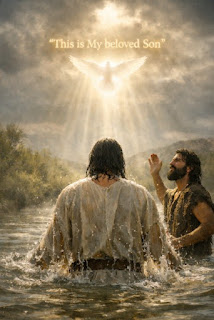
    At Jesus’ baptism we see yet another strong reference to the Trinity. Aberrant groups such as the Jehovah’s Witnesses, the Mormons, and Oneness Pentecostals try to deny the Trinity, but John will not allow it! We have God the Son being baptized, and God the Spirit descends upon him. John doesn’t include this, but also at this moment Matthew 3:17, Mark 1:11, and Luke 3:22 say that God the Father spoke audibly from heaven! We have all three persons of the Trinity mentioned in this act of baptism. So clearly, this act carries a lot of significance. The questions that came up in my mind as I read this are why do all three persons of the Trinity show up in this act, and why was Jesus baptized?

    Let’s start with the second question, “Why was Jesus baptized?” John the Baptist baptized people for the repentance of sins. People would confess their sins and then be immersed in water, which symbolized their cleansing from sin. However, we maintain that Jesus never sinned…so why be baptized? People have had different ideas to answer this. Sinclair Ferguson, along with others, have said that people symbolically left their sin in the water upon being immersed. So we have the perfect, righteous Jesus being immersed into this “sin-filled” water where he foreshadows the exchange about to take place. Jesus will take our sins upon himself, and we will be granted his righteousness. So just like in baptism where we leave sin behind in the water, we leave sin behind because they were placed on Jesus!

    Another reason for his baptism was brought up one time while I was listening to the radio in my car. Priests would wash themselves before performing priestly duties. Likewise, Moses washed Aaron and his sons with water when being put into their priestly service in Leviticus 8:6. It could be that Jesus’ baptism was supposed to be his ordination as High Priest! Moreover, remember that John the Baptist was from the tribe of Levi. So we have here a Levite baptizing a person from the tribe of Judah into the priesthood. Perhaps this was a way of recognizing a change of priesthood, as explained in Hebrews 7:11-19. Jesus’ priesthood was not one where sacrifices had to be given over and over again. His priesthood entailed him giving himself once and for all!

    Now that we have briefly answered that question, we can now answer the question, “Why do all three persons of the Trinity show up in the baptism?” Perhaps the best way to explain this is that this is God’s seal of approval on Jesus’ mission. This was God’s way of showing to others that Jesus was sent from the Father, and his ministry is empowered by the Holy Spirit. Jesus is not just an ordinary, average human. He is God in the flesh.

    Another thought that came to mind is that by all three persons showing up, God is further revealing his triune nature now that Jesus has arrived. There was somewhat of an understanding of the Trinity in the Old Testament, but Jesus’ arrival clarified it. In the Old Testament, we have instances where people worship and give offerings to the “Angel of the Lord”, and other instances where the Spirit of the Lord descends upon people to empower them for certain works. However, we usually don’t read of the Father, the Angel of the Lord, and the Spirit working together all in the same passage. Here, though, in John we see all three persons working together at the start of God’s mission to rescue humanity!

    A final thought on the Trinity in Jesus’ baptism is that in this passage Jesus is referred to as the one who baptizes with the Holy Spirit. We see in this what Jesus will eventually allow for all believers under the New Covenant. All believers will be empowered and filled with the Holy Spirit. It will no longer be like the Old Testament where the Spirit temporarily fills people for works. The Spirit will remain upon us. So Jesus’ baptism is also an example for us to follow and is a demonstration of what happens when we are adopted into the kingdom! We become God’s child, we become part of a royal priesthood, and we are empowered and filled with the Holy Spirit!

    This passage is filled with so many good things…the fulfillment of the Passover Lamb in Jesus, the Trinity, the initiation of Jesus as High Priest, and the infilling of the Holy Spirit. This should all fill us with thankfulness and awe at what God has done through Jesus…and we’re still just at the beginning of John!

  • John 1:19-28

    19 This is the testimony of John, when the Jews sent priests and Levites to him from Jerusalem to ask him, “Who are you?” 20 And he confessed and did not deny; and this is what he confessed: “I am not the [w]Christ.” 21 And so they asked him, “What then? Are you Elijah?” And he *said, “I am not.” “Are you the Prophet?” And he answered, “No.” 22 Then they said to him, “Who are you? Tell us, so that we may give an answer to those who sent us. What do you say about yourself?” 23 He said, “I am the voice of one calling [x]out in the wilderness, ‘Make the way of the Lord straight,’ as Isaiah the prophet said.”

    24 And the messengers had been sent from the Pharisees. 25 They asked him, and said to him, “Why then are you baptizing, if you are not the [y]Christ, nor Elijah, nor the Prophet?” 26 John answered them, saying, “I baptize [z]in water, but among you stands One whom you do not know. 27 It is He who comes after me, of whom I am not worthy even to untie the strap of His sandal.” 28 These things took place in Bethany beyond the Jordan, where John was baptizing people.

    Today’s post will cover more verses since the first 18 verses had a lot of content. We now will see that John switches a narrative style of writing.

    This section for today explains the relation of John the Baptist to Jesus. John the Baptist gets a backseat to Jesus, but that backseat position is still very important. As seen in history, the person who gets the most credit and notoriety always has people coming before them (or accompanying them) that set them up to do great things. For example, Martin Luther could not have been as effective without forerunners like Jan Huss and John Wycliffe.  RC Sproul would not have been such a well-known teacher and author without the influence of John Gerstner. John Macarthur would not have been what he was without the influence of his father. Martyn Lloyd Jones might not have become what he did without G Campbell Morgan coming before him. God has ordained that some people prepare the way for others, which is not something to be scoffed at. And such is the case with John the Baptist. Jesus is God, so he technically can do anything, but God ordained that John the Baptist would prepare the people of Israel for Jesus’ ministry.

    Starting in verse 19, we know that John had a well-known baptism ministry. Mark 1:5 says that many of the people in the regions where he was baptizing went to him to be baptized or hear him speak. News of his message and baptism had reached the ears of Jews in Jerusalem. As such, the Pharisees want to find out who exactly John is. They ask him, “Who are you?” In other words, “Who do you claim to be?” This is a very important question. At this point, John could’ve claimed to be someone greater than he was. He apparently was a popular figure, and so here could have been his chance to get more fame. He is so popular that it almost seems like the messengers are expecting him to say that he is the Messiah! But in verse 20, he says plainly that he is not the Christ. He is not the Messiah. He is not the one Israel is waiting for to rescue them.

    So he isn’t the Christ, but that leaves two other possibilities. They ask him if he is Elijah. Where is this coming from? Malachi 4:5 says that God will send Elijah before the day of reckoning. In other words, Elijah will come before God is about to do something big. However, John denies being Elijah. What is funny about denying that is that Jesus says in Matthew 17:12 that John was Elijah – not a reincarnation of Elijah – but he came in the “spirit” of Elijah. What I mean is that John came to do similar works that Elijah did. Elijah was known for his call to repentance, and John the Baptist played a similar role.

    John is not Elijah, but that leaves the possibility that he might be the Prophet. What is meant by this? In Deuteronomy 18:15 Moses prophesies that a prophet like him will come and the people must listen to him. So this “prophet” will be like Moses. Most Christians believe that this particular prophet was Jesus, but the Jews didn’t know that at the time. Again, though, John denies that he is the Prophet.

    In verse 22 we see that John’s denial of being the Christ, Elijah, or the Prophet confuse the messengers. In verse 23 he reveals his role. John is the fulfillment of Isaiah 40:3. Going back to Isaiah 40-66, this great section communicates the majesty, sovereignty, and consolation of God. Among other things, God declares that he will restore his people. In Isaiah 40 specifically, there is a part where Isaiah says someone will come to comfort God’s people. John the Baptist came to fulfill that role! He was born to declare God’s comfort to his people in that the Messiah had come! The world had been waiting the arrival of a redeemer, and John had the privilege of preparing God’s covenant people for it!

    Going now to verses 24 to 28, the messengers are still confused as to why John baptizes people for repentance if he isn’t the Messiah, Elijah , or the Prophet. Speaking of baptism, this practice was not new to John. In the Old Testament there were instances where people would immerse themselves in water in a pool of water called a mikvah to symbolize cleansing. For example, men with a discharge in Leviticus 15:1-5, women after their periods in Leviticus 19-21, priests before beginning their duties in Leviticus 16:1-4, people after touching a dead animal in Leviticus 17:15, and anyone who touched a dead person in Numbers 19:11-12 had to be immersed in water (baptized) to either be declared clean or be set apart. As you can see, baptism was associated with being cleansed of something. The water itself did not cleanse you, but it was a visible portrayal of an invisible reality. Later on in the intertestamental period (the time between the Old and New Testament), baptism began to be associated more specifically with the forgiveness of sins. Jews also would baptize converts to Judaism, and the Essenes were known for baptizing individuals who wished to join their community and to be cleansed of sin. The Essenes were a group of Jews who lived out in wilderness areas and sort of lived like monks. Some think John may have been a part of this group and carried over their understanding of baptism.

    Going back to John 1:24-28, the messengers and Pharisees would have been familiar with baptism and washing, so it was confusing to them why someone insignificant would be performing mass baptisms. And so John gives them the reason for it. He basically says that he is baptizing for repentance because someone has come who is far superior to all other humans. He is so superior, that John is not even worthy to untie his sandals. Once again, this has to do with John’ mission. He came to prepare people for Jesus. John came proclaiming repentance, and Jesus would preach the same message!

    In conclusion, I think we can say two main things about this passage. One, we clearly see Jesus’ supremacy in this passage just like we did in 1:1-18. This is John’s main message. John the Baptist is seen as a great man, but John confesses that there is someone even greater coming! May we all emulate John’s proper positioning of himself in relation to Jesus! Secondly, we should not underestimate the importance of what some might call “lesser service” for God. John was not the Messiah and his work might not be seen as glamorously as that of Jesus and the apostles, but his work was extremely important nonetheless.  There is great value in those who do legwork. Really, it should be said that ALL work done for the Lord is of great value!

  • John 1:14-18

    Just as a warning, some of today’s post may be a bit complicated. Please let me know if anything is unclear!

    14 And the Word became flesh, and dwelt among us; and we saw His glory, glory as of the only Son from the Father, full of grace and truth. 15 John testified about Him and called out, saying, “This was He of whom I said, ‘He who is coming after me has proved to be my superior, because He existed before me.’” 16 For of His fullness we have all received, and grace upon grace. 17 For the Law was given through Moses; grace and truth were realized through Jesus Christ. 18 No one has seen God at any time; God the only Son, who is in the arms of the Father, He has explained Him.

    V14 – We read previously how the Word of God is God himself and was yet with God from the very beginning. In another post I mentioned that the beginning of John allows for introductory remarks on the Trinity. We have historically understood God to exist as three persons – Father, Son and Holy Spirit. When we get to verse 14, though, we see something extraordinary – the Word became flesh and lived among us. The reason for him becoming flesh is given in verses 17 and 18. He came to give grace and truth and to reveal the Father. I will come back to this in a little bit, but may we never underestimate the goodness of God in these verses! God could have left us without revealing grace and truth, but yet he chose to. Jesus could have stayed with the Father, and yet he voluntarily decided to be like one of us. It would be like a king or president revoking their privileges in order to serve common people… but multiply a king or president’s honor and privilege a billion times over! We should be amazed at the God who condescended to us to then die for us. And that’s something else to contemplate… God, in eternity past, decided to die for his creation. Why would God create or allow these circumstances to occur, such that God himself would die in the flesh on a cross? Why not create a world where sin would never occur and therefore avoid death and resurrection? Why even create a universe where the first two humans sin? These are questions we don’t have exact answers for, but a basic response would be that God did it simply because he wanted to and to receive glory. God doesn’t need the praises of anyone, but his receiving glory results in benefits for us. Colossians 1:16 says that all things exist FOR him. He also says in Ephesians 1 that he has redeemed a group of people to be “to the praise of his glory”.

    Something else to think about is how is it possible for God to become flesh? How is it possible for a body to contain all the deity of God?? This, again, is a mystery in God. It seems an impossibility to put together these two natures into one person! However, detracting from either nature detracts from Jesus’ mission on earth. If Jesus is just a man or just God, then he couldn’t accomplish anything for us. If Jesus were just a man, then it would be impossible for him to not sin. If Jesus were only God, then it would be impossible for him to serve as a sacrifice for us. As such, early Christians who thought and debated over this said that Jesus is both fully man and fully God. This is expressed in the Athanasian Creed, which was a declaration and clarification of the Trinity. This creed was traditionally attributed to a man named Athanasius in the 300’s AD, but some think that it was written somewhat later in the 400-600’s AD. And then later on in 451 AD the Chalcedonian Creed was written to further define the unity of God and man in the person of Jesus. The Athanasian Creed addressed the question of the union of God and flesh more on a side note, whereas in the Chalcedonian Creed the dual, but united, nature of Jesus is front and center. Here is one translation of the Chalcedonian Creed with my underlinings,

    “We, then, following the holy Fathers, all with one consent, teach men to confess one and the same Son, our Lord Jesus Christ, the same perfect in Godhead and also perfect in manhood; truly God and truly man, of a reasonable soul and body; consubstantial with us according to the manhood; in all things like unto us, without sin; begotten before all ages of the Father according to the Godhead, and in these latter days, for us and for our salvation, born of the virgin Mary, the mother of God, according to the manhood; one and the same Christ, Son, Lord, Only-begotten, to be acknowledged in two natures, inconfusedly, unchangeably, indivisibly, inseparably; the distinction of natures being by no means taken away by the union, but rather the property of each nature being preserved, and concurring in one Person and one Subsistence, not parted or divided into two persons, but one and the same Son, and only begotten, God the Word, the Lord Jesus Christ, as the prophets from the beginning have declared concerning him, and the Lord Jesus Christ himself taught us, and the Creed of the holy Fathers has handed down to us.1

    The union of God and man in the person of Jesus is called the hypostatic union. There were others who denied this perfect union. Groups such as the Nestorians, monophysites and Arians denied this teaching. I won’t go into more detail here, but the union of God and man in Jesus is something to marvel at, deeply appreciate, and realize that without it there would be no redemption!

    Going back to our passage, in verse 14, John says that in Jesus we see God’s glory. In other words, we see God’s excellence and magnificence in Jesus. As a side note, if you had never the read the Bible John 1 could be a little confusing. He seems to give a very majestic description of someone who, to the majority of the world, is just a nice man or prophet. To add more mystery to Jesus and the nature of God, we then read a word that has never been fully understood by anyone. The NASB says, “glory as of the only Son of the Father”. The Greek says, “glory as of the ‘only-begotten’ of the Father”. Jesus is said to have been “begotten” by the Father. The NASB reflects the preference of some to abandon the idea of Jesus being “generated” from the Father. Rather, “only-begotten” is taken to refer to Sonship only. However, classical understandings of the Trinity support the notion of the Father “begetting” the Son. Personally, it is hard for me to understand the Trinity in general, but this aspect of it is the most difficult part to understand. To beget someone is typically understood as conceiving a child. However, this can’t have the same meaning here. If God is the Father of Jesus like humans are fathers, then that means that Jesus was created and there might potentially be a mother. The Jehovah’s Witnesses affirm that Jesus was created, and the Mormons affirm both parts of the above statement! Mormons believe that God the Father has a “wife” called Heavenly Mother! However, we should strongly deny any creating of Jesus where Jesus had a beginning point. I’ve written in other posts why we should deny this. To combat this, church fathers and scholars typically have said that Jesus is “eternally generated” by the Father. He is not created!

    Robert Letham in his Systematic Theology has a helpful section on this. He says, “Eternal generation reflects the incomprehensibility of God and is a transcendent mystery, beyond the grasps of our minds…This was uniformly recognized by the fathers; for them it was a great mystery.”2

    Wayne Grudem in his very popular Systematic Theology says the following, “Eternal generation means that the Father eternally communicates to the Son the divine essence so that the Son fully shares in every attribute of the Father…And because this generation is eternal, the Son was not created but eternally existed as ‘the only begotten Son’…Eternal generation means that the Father is the source of the personal distinctions between Father and Son, but he is not the source of their divine essence.”3

    This might seem confusing, but to summarize Grudem…somehow in terms of personhood (not essence), Jesus should be thought of as proceeding forth from the Father. Jesus and the Father are the same in essence, but the personhood of Jesus is derived from the Father and somehow not lesser in status than the Father’s person. All this may seem irrelevant, but Herman Bavinck explained why eternal generation is to be appreciated, “Without generation, creation would not be possible. If, in an absolute sense, God could not communicate himself to the Son, he would be even less able, in a relative sense, to communicate himself to his creature.”4 So, while God expresses his nature through us in a partial sense, God’s nature is expressed in an eternal and infinite way through the Son (I hope my wording is correct)! Again from Bavinck, he says that eternal generation shows God to be “no abstract, fixed, monadic, solitary substance, but a plenitude of life. It is his nature to be generative and fruitful.”5 If anything, this doctrine shows me how I know so little about God! Also, please let me know in the comments if you’d like a separate post on this doctrine.

    Going on to verse 15, John the Baptist teaches others the eternality of Jesus. Yes, Jesus was born in a body in Bethlehem a long time ago, but he existed before he was born. This has already been noted. As such, he is superior to us.

    Verses 16 and 17 go together. Moses gave us the Law, which was good and necessary, but the Law was useless in fixing our broken relationship with God. The problem was not the Law; rather, the problem is us! If you read Romans chapter 2, you will quickly see that the Law could never put us in good standing with God because no matter how hard we try we can never always obey the whole Law. All it does is condemn us and declare that we’re guilty. So Jesus came to fix that. He gave us grace and truth. We had the truth as revealed in the Law, but there was no grace to be found in it. Without grace, we can never be in good standing with God. And thanks be to God that Jesus came in the flesh to give us grace! And truly, as John puts it, it is “grace upon grace”!

    Now we come to the last verse for today, verse 18. No one has ever seen God. Yet, in the Son, we do see God because he is God. And once again in verse 18 we see the Greek word for “only-begotten”. “God the only Son” should be translated as “only-begotten God”. So again we see a clear indication that Jesus is God and yet is begotten by the Father.

    John 1 so far is a huge problem for those who deny the deity of Jesus or confuse him in other ways. Over and over again we see this teaching that Jesus is God and yet is distinct from the Father.  But, it is understandable why it can be easy to misunderstand who Jesus is because his nature and essence are beyond our comprehension. He is fully man and fully God. He is God yet took on flesh. He is somehow eternally generated by the Father yet is still God. I certainly don’t know how to fully explain these things. While some may look at these mysteries and reject God because he is not 100% understood by us finite creatures or because they want a god that is tamer, these things make me lean into him more. They amaze me. They make me want to know more about God. And finally, they make me trust in his wisdom and power. If God can somehow work out how Jesus can be God and man at the same time, if he can work out how a baby can be born to a virgin, if he can work out things like eternal generation, then I can trust him with the details of life.

    1 Schaff Phillip. The Creeds of Christendom with a History and Critical Notes. Harper & Brothers; 1877:62.

    2 Letham Robert. Systematic Theology. Crossway; 2019:116.

    3 Grudem Wayne. Systematic Theology: An Introduction to Biblical Doctrine. 2nd ed.  Zondervan; 2020: 298.

    4 Bavinck, Herman. Reformed Dogmatics. Vol 2 (Bolt J, ed.). Baker; 2003-2008:420.

    5 Bavinck, Herman. Reformed Dogmatics. Vol 2 (Bolt J, ed.). Baker; 2003-2008: 308.