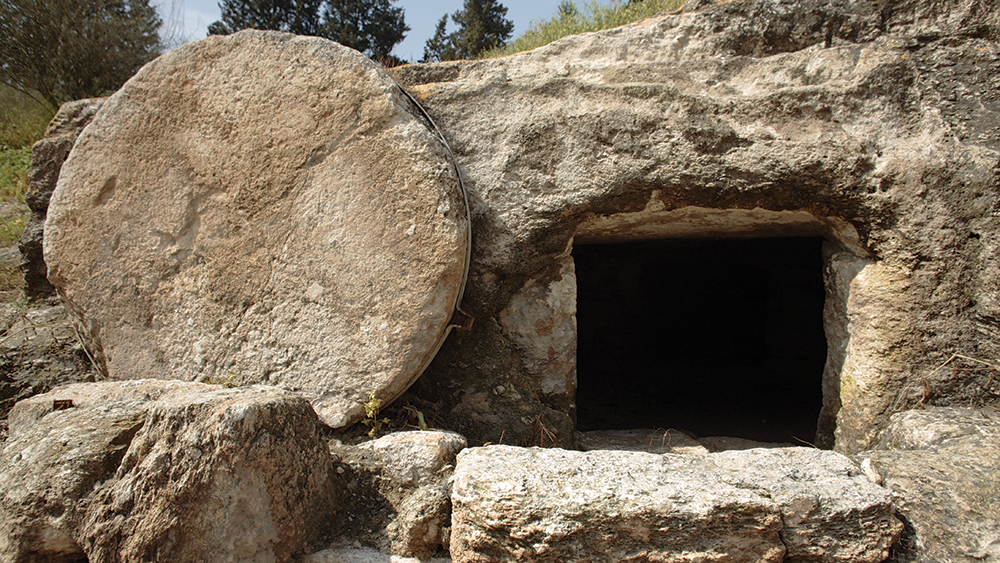
3. No other major religion has a central figure that is resurrected
We’re still on this series of blog posts concerning why to believe the Bible, and on the particular point that the Bible’s message is unique. The third and final point demonstrating the uniqueness of the Bible’s message is that no other major religion has a central figure that is resurrected. There are two things to address inunderstandingwhy this is so important.
1)How can we know if Jesus of Nazareth was really resurrected?
2)What does it matter if he was resurrected?
For the first point, the claim for a resurrection would be crazy if there were no eyewitnesses. However, the apostle Paul in 1 Corinthians 15:3-6 states that Jesus appeared to over 500 people after his resurrection. He stated that fact in the context of a false teaching that was being spread at the church in Corinth – that there will be no resurrection. To counter this, he pulls out this fact that many people saw Jesus after coming back to life. That is the most compelling argument for knowing if Jesus was truly resurrected. In any argument, eyewitnesses always help the credibility of an argument.
Secondly, the fact that at least some of the original twelve disciples died for their claims concerning Jesus also gives credibility to his resurrection. Traditionally, it is believed that eleven of the original twelve disciples died for this belief. However, others doubt that as many as eleven died. One author, Sean McDowell, believes that five of them were likely to have been killed, with the rest not so likely1. Another one, Edward Gibbon, claims that only three of them were killed2. As far as I’m concerned, even if only one of them died for the faith, it still shows that even that singular person was willing to risk their life on a claim of the resurrection. You would have to be not quite right in the head to die for something you know to be a lie! Along these same lines, consider the apostle Paul. He states in his own words that he persecuted Christians. What else would change him so radically except for the resurrected Jesus?!
Thirdly, most of the disciples doubted at first that Jesus had risen from the dead. If someone is looking to start a movement, then it doesn’t seem like a good idea to include that the central figure’s own followers doubted his resurrection!
There are other reasons for believing that the resurrection occurred, but those three seem to me the most noteworthy reasons. Of course, one can always doubt the resurrection no matter what reasons one gives. One can always adopt the attitude, “I wasn’t there, so I won’t believe.”, or “There isn’t absolute proof for this supposed resurrection.” This would be the same as doubting, for example, that the Civil War took place in the 1860’s or that Alexander the Great was the ruler of an empire simply because “I wasn’t there” or “there aren’t any videos to prove the occurrence of these events”. People generally don’t doubt that those events took place (even without videos or personal conversations with eyewitnesses), yet we doubt and demand more proof for Jesus’ resurrection. Who knows…maybe the documents from the Civil War are fakes? Maybe ancient historians made up everything we know about Alexander the Great. With that in mind, Jesus was correct in saying, “Blessed are those who believe without seeing.”
For the next point (why does a resurrection matter), the resurrection is what validates the Christian faith! As was explained in previous posts, sin (and its result – death) is our biggest problem. It pits us against one another and God. Without Jesus’ resurrection, our sin problem remains (1 Corinthians 15:17). As such, Christianity is the only religion that actually provides a valid solution for the problems of sin and death! Again referring to past posts, we see an ignoring of transgressions in other religions. In Islam, Allah merely forgives sins without demanding justice. In Hinduism and Buddhism, one gets many chances to try and make up for one’s wrongdoings. In Christianity, we recognize that the God of the Bible is much too “other” and perfect for us to attempt to please him with our own efforts. In other words, God is too perfect for us, but he’s also just. He has a lot of patience, but he eventually demands justice for all wrongdoings. He cannot simply let sins slip by unnoticed. At the same time, though, God is described as loving and merciful. In his immense love for us, he sent Jesus his son to take our punishment for us. In Jesus, therefore, we see the meeting of justice and mercy. No other religion provides such a solution for our problem of sin and death!
The resurrection, then, validates Jesus’ claims to divinity. He predicted his death and resurrection in Matthew 17:22-23, among other passages. In John 11:25 Jesus states that he IS the resurrection and the life, meaning he is the source of both. To be able to rise again points to the fact that Jesus is indeed divine. He is God himself (John 8:58, Titus 3:4, etc), and that changes everything! Only God can overcome the curse of death he placed on humanity in Genesis 3:19. As such, this means that all of Jesus’ teachings and other claims must be true if he is God himself. This means that our sin is forgiven in him. This means that we have peace with the Father through him. This means that he is the way, the truth and the life. The death and resurrection of Jesus are the central acts of all history because they opened a door for us to be able to commune with the Father.
No other religion has a central figure that is resurrected. Muhammad, Buddha, Guru Nanak (founder of Sikhism), Joseph Smith, etc all died and their bones remain there. Jesus is the only religious leader who died and then came back to life. As such, the claims of Christianity are unique in this aspect. These claims are all found in the Bible, which again, means that the Bible is unique and should be considered as divine in its origin.
In conclusion to this first overarching point concerning the fact that the Bible’s message is unique and this therefore supports its divine origin, I truly believe that the Bible describes our condition and the nature of God most accurately out of any religious textbook. It’s pages are filled with human failings (sin), but it’s also filled with God’s mercy and grace extended to us time and time again. On the cross, we see this unique meeting of justice, mercy, grace, and love, which is then validated in the resurrection. The perfect one takes the place of the imperfect multitude, and yet through God’s power he overcomes the original curse placed on Adam. This truly is good news, and no other religious book has a message that quite compares!
1 McDowell, Sean. n.d. The Fate of the Apostles: Examining the Martyrdom Accounts of the Closest Followers of Jesus. 2nd ed. London and New York: Taylor and Francis Group.
2 Gibbon, Edward. n.d. The History of the Decline and Fall of the Roman Empire. Vol. 2. New York: J&J Harper.
 Thinking Theo
Leave a comment