Month: May 2026

  • John 1:6-13

    V6-9 – A man came, one sent from God, and his name was John. He came as a witness, to testify about the Light, so that all might believe through him. He was not the Light, but he came to testify about the Light.

    Starting in verse 6, we see the first mention of John the Baptist. Verse 7 says he came to testify about Jesus. We cannot underestimate the importance of John the Baptist. Remember that his birth was foretold by the angel Gabriel in Luke 1. Matthew 3:3 says that John the Baptist was the fulfillment of Isaiah 40. Indeed, John had the unique mission of preparing the people of Israel for the arrival of Jesus. Jesus told a group of listeners in Matthew 11 that John was one of the most important prophets to have ever lived! And what is amazing about John is that he never once looked for credit in what he did. His life was completely focused upon the arrival of Jesus. John could’ve received a lot more attention than he did, but in John 3:30 we see his attitude, “He must increase, but I must decrease.” Probably not many people would willingly copy John’s statement. However, his attitude should be ours!

    In verse 7 we see the purpose of John’s work…”so that all might believe through him”. However, the purpose was not to make people believe in himself, but rather to believe in Jesus! How many people make huge efforts to get attention for themselves? How many people spend much of their life trying to make themselves great? But how many people work hard to make someone else look great? We see here that John worked hard to get people’s eyes on Jesus, not on himself. John wanted for everyone to see how great Jesus is.

    Something that comes up as a question in my mind is how to reconcile “so that all might believe through him” with other passages where it is clear that not all will be saved. The Bible also seems to teach that God chooses people to be saved. This is a concept that I’ve fought long and hard with, but I see no way around it and am done fighting it. I’ll just give a few examples to support this. In 1 Thessalonians 1:4, Paul says that we know God chose you Thessalonians because when we preached to you our message came with conviction and the Holy Spirit. In other words, we know God chose you in advance because when we came to you God was at work. In Romans 8:29 God foreknows believers. To “know” someone in the Bible oftentimes has a sense of intimacy. So God “knows” his people before the world began! You and I had nothing to do with him choosing to foreknow us. Ephesians 1:11 says that God works everything in accordance with his will. This applies to everything… even to individual salvation. Ephesians 1:4 says that God chose us (believers) in him (Jesus) before the foundation of the world. He chose us. He chose you if you’re a believer. He chose me. God ensured that there would be a group of believers. Some would like to believe that God chose merely a group of people, and that that does not extend to him choosing individuals. However, I don’t see how that can work. If I choose for the NY Knicks to win the NBA championship this year, doesn’t that imply that I chose current players like Jalen Brunson, Karl-Anthony Towns, Mikal Bridges, etc to win? If God chooses a group to be saved, then this presupposes that that group is composed of individuals who are also chosen! I don’t see how a Christian could say that God chose believers as a group but not me as an individual. The only way this could work is if I by my own will placed myself in this chosen group. However, 1 Corinthians 1:30 says that it is because of God that I am in this group in Christ! 1 Corinthians 2:14 says that a natural (unsaved) person does not and cannot understand the things of God. So how can I put myself in this group of believers if I can’t even accept the things of God? To understand the things of God, I must be changed, regenerated, by God. So again, it is God who places me in this chosen group!

    So how do we reconcile this with John preaching “so that all might believe”? I’m not sure how to best answer it, but one thought that comes to mind is that in one sense God truly does desire that all would be saved, but at the same time he doesn’t. That seems contradictory, but we humans do it all the time. Parents typically don’t enjoy disciplining their kids, but they do so anyway because they have a higher desire to improve their child’s future behavior. So one hand, we parents don’t like disciplining our kids, but one the other hand we do! We have two wills at work at the same time. I see no problem in applying this to God, and this is how the Church has historically understood God’s ways. He does desire in a sense that all to whom John preached would believe, but yet he did not choose all of John’s listeners to be saved. This answer may not be satisfactory for some, but I’m ok with not understanding everything about God.

    V9-13 – 9This was the true Light that, coming into the world, enlightens every person. 10 He was in the world, and the world came into being through Him, and yet the world did not know Him. 11 He came to His own, and His own people did not accept Him. 12 But as many as received Him, to them He gave the right to become children of God, to those who believe in His name, 13 who were born, not of blood, nor of the will of the flesh, nor of the will of a man, but of God.

    Again we return to Jesus as the Light. Jesus as the light enlightens every person. Now we need to ask what is meant by “enlighten”. I don’t think we have to make this too complicated. In English, when we say that we “shed light” on something it means we made something better understood. I think it has, more or less, the same meaning here. Jesus gave us greater understanding as to who God is. Hebrews 1:1-3 says this, “God, after He spoke long ago to the fathers in the prophets in many portions and in many ways, [a]in these last days has spoken to us [b]in His Son, whom He appointed heir of all things, through whom He also made the [c]world. [d]And He is the radiance of His glory and the exact representation of His nature, and [e]upholds all things by [f]the word of His power…” Do you see that? God spoke to us through his Son. The Son is also his radiance and the “exact representation” of his nature. When we look upon the Son, we see God. Through Jesus we come to have a clearer understanding of God. In this way, Jesus “enlightened” us.

    Verse 10 is a very sad verse. Jesus came to his own creation. John 1:3 says that Jesus is the creator. Nevertheless, his own creation did not know/understand/recognize him. How dull must we humans be to not even recognize the creator! If any verse points to our natural depravity, this has to be one of the top ones! And yet we see the same concept at work in our day. How many blessings do we receive, and yet many fail to recognize the one who blessed us? How many people look at nature and don’t conclude that someone great and powerful must have designed all of it? We have evidence of God all around us, and yet many people are too dull to acknowledge it or willfully reject such an acknowledgement!

    And verse 11 says that because we didn’t know him, we didn’t accept him. It’s very true that we tend to reject those things that we don’t understand. And by not accepting, John is saying that we killed him in a nice way. It’s not that we ostracized him or mocked him…the Romans and Jews worked together to kill the Son of God.

    Let’s go to verse 12. Verse 12 is better news. Not all rejected Jesus! The same is true in our time…not all reject him. To those who love and follow God, God adopts those persons into his family. Connecting this to verse 13, we learn that those who are adopted by God were born of him. He gave them life. It was God’s decision to give life to those who would believe. This verse highlights that the decision to believe didn’t come from ancestry or our will; rather, those who believe were born of God. In other words, you believe because you were born of God. This verse shows the supremacy of God’s will in the matter.

    And this doctrine of adoption is truly a wonderful teaching. My wife and I adopted 4 kids. When I think back on the process, our kids did absolutely nothing to be adopted. We first had the desire and plan to adopt kids. Out of that desire, we began looking for kids that needed adoption. And we were matched with the kids we would later adopt. We did all the paperwork, we flew out to Texas to meet them… we initiated everything. They did nothing. All they did was receive the benefits of our choosing them. I think this is the same for Christians. You and I did nothing to be saved. God had the desire and plan to have adopted children long before we were born. He knew we would fall into sin, but he planned to save us. Yes, I did have to exercise faith, but many of us believe that even the act of having faith was due to God’s Spirit working in us and regenerating us (see 1 Corinthians 1:30, 2:14). He brought forth in time what he had planned in eternity past! The beauty of this teaching is that God gets all the credit. It also makes me all the more thankful for what he did.

  • John 1:3-5

    V3 – “All things came into being through Him, and apart from Him not even one thing came into being that has come into being.”

    Continuing on this biblical commentary, I wrote yesterday about John equating Jesus as God. In verse 3, John gives us further insight into the triune nature of God. Verse 3 says that all things came into creation THROUGH Jesus. Nothing came into existence apart from Jesus’ act of creation. I think when we imagine the creation of the universe, we usually picture the Father creating everything. And this is because Jesus’ name isn’t mentioned in Genesis 1. The Spirit is mentioned, but not God the Son. Here, though, and in Colossians 1:16, we understand that the Father did create the world, but it was THROUGH Jesus. Colossians 1:16 says this, “For by Him all things were created, both in the heavens and on earth, visible and invisible, whether thrones, or dominions, or rulers, or authorities—all things have been created through Him and for Him.” Again we read that everything was created through Jesus.

    What is also significant is how in Genesis 1 we see different times when God “speaks” things into existence. His “Word” brings things into existence. I am making a correlation between God’s spoken “words” with “The Word”. That is, when the Father proclaims that something will be made, Jesus puts into action what the Father wills. And, Jesus puts it into action because his will is identical to the Father’s will since Jesus is God. This is, I think, how the Father and Son worked together in the act of creation.

    This verse alone should cause us to be amazed at the power and authority Jesus has. He is not some blonde-haired guy lying down in a field somewhere with animals and flowers. No, Jesus is God Almighty! He is the maker of heaven and earth! Jesus commands, and what he says comes to pass!

    V4 – “In Him was life, and the life was the Light of mankind.”

    Just as Jesus had the power to create the universe, stars billions of miles away, the organs in our bodies, and even atoms and protons and quarks, Jesus also has life in himself. But what is meant by life? Is this just referring to his ability to create more humans? I don’t think so. I think that this refers to life we find in God. In Genesis 2:17 God tells Adam that he must obey him or he will die. Adam did eventually die physically, but even more significant was his separation from God starting that day. This was a spiritual death. Our connection to God is what true life is. He is more important for us than food, water, shelter, and oxygen. Without him, we’re just walking corpses. Without a connection to God, we are meaningless, hopeless and corrupt. Ephesians 2:2 says that we were “sons of disobedience”. Ephesians 2:3 says we were “children of wrath”, meaning we deserved God’s anger toward us. If God isn’t with us, we are nothing. Jesus says in John 15:5 that apart from him we can do nothing. God is the source of all good, so without him we turn into what He is not – corruption and decay.

    So Jesus is life and this life is the light of mankind. As we go through John, we’ll see different metaphors that Jesus uses to describe himself. He is the bread of life (6:35), the good shepherd (10:11), the resurrection and the life (11:25-26), the way, truth and life (14:6), and the true vine (15:5). All of these show us how badly we need him!

    V5 – “And the Light shines in the darkness, and the darkness did not grasp it.”

    This verse has so much application in it. Jesus, the light of mankind, shines into our darkness. If darkness is the absence of light, then darkness in this context must mean when God is absent. Yes, God is omnipresent (everywhere), but we can choose to push away his light from us. And the further God distances himself, the greater that darkness becomes. By rejecting God, we embrace all sorts of evil and sin because we love darkness instead of light.

    And now notice something about the darkness. The darkness did not “grasp” the light. The word for “grasp” can be translated as “overcome” or “perceive”. In this context, any of those translations would be acceptable. If the darkness did not “overcome” the light, then this demonstrates Jesus’ power and authority. This is certainly true because if we are familiar with Jesus, then we know that humans killed him out of anger and jealousy. However, he rose from the dead just 3 days later. In this way, the light “overcame” the darkness. The world hates God, and yet God overcame our attempts at evil! If we say the darkness didn’t “perceive” or “comprehend” the light, then we can know that the world in its sin didn’t understand Jesus. This was also true. The Jews, as a whole, didn’t know what type of Messiah Jesus was going to be. The Pharisees were confounded by Jesus. They didn’t understand his answers to their questions, and they definitely didn’t understand his way of doing things. Their idea of God was a manufactured one. So when the true light came into the world, they didn’t understand his ways. And what did they do because they didn’t understand him? They killed him.

    In conclusion, the first 5 verses of John give an outstanding idea of who Jesus is. He is God himself. He is the creator. He was there in the beginning. He is life. He is light. And all that he is has overcome the darkness of the world. He was not a mere man like many claim. He was and is much more than that. Jesus, God in the flesh, came on a rescue mission, and for those of us who believe, he shined into our darkness to give us the life that is in God…life that is real life 🙂

  • A New Direction and John 1:1-2

    I apologize for not writing anything for a while. I was trying to think of things to write about after finishing reasons to believe the Bible! It dawned on me that instead of trying to come up with different topics, I could just go through the Bible slowly (very slowly). To begin with, I’ll go through John. And hopefully, this will help someone out there as they read through the Bible. John is a very deep book, and in it we discover just how high and great Jesus is. John also had a unique way of expressing things. From the very beginning of the book, John presents Jesus as much more than a mere human. Yes, he is human, but he is God at the same time. There are other themes in the book, but these will become clear to you if you read these posts. From here on out, the normal way I’ll write on this blog will sort of be like my own personal commentary. So let’s get started…

    V1 – “In the beginning was the Word, and the Word was with God, and the Word was God.”

    As we begin, let it be known that John 1:1-5 is one of the most eloquent opening passages in the Bible. Each verse is packed with meaning and things to be understood. So it’s fitting to start with verse 1. We first though need to ask a very important question.

    Who or what is “the Word”?

    If you’ve been in any church for any amount of time, you will most likely know that “the Word” is commonly understood to refer to Jesus. But how do we know this? John uses “the word” (logos in Greek) to appeal to Jewish understanding and Greek philosophical thoughts of his time. For Greek philosophers, logos referred to a principle of reason or order in the universe. Put another way, Greeks thought of logos as a type of force through which the universe runs. It’s sort of like how people talk about “mother nature” when referring to the way in which nature works. Mother nature is seen as an impersonal force that seems to make things in nature run smoothly. For the Greeks, logos was an impersonal concept. John, however, will make it very obvious that God’s concept of logos is a person…not a force or principle!

    If John’s reader was Jewish, then he/she would understand logos in a different way. Remember that Jews at this time period read the Greek translation of the Old Testament called the Septuagint. For Jews, the word of God was the way in which God communicates himself to us. It is also by his word that God created everything and put into place everything that is (see Genesis 1). John is giving life and personhood to the “word” of God!

    Now we can say several things about the Word…

    1.The Word was there in the beginning

    The first part of this verse should remind us of Genesis 1:1 (In the beginning God…). Instead of saying God was in the beginning, he replaces God with “the Word”. When nothing of our world yet existed, the Word was there. God was there and the Word was there. Without even considering the last phrase of verse 1, it should be understood that the Word and God are interchangeable. And if we understand the Word to be Jesus (which John will explain later in the chapter), then the correlation is made that Jesus was around before we began. This alone sets him apart from us. He is like us, but he’s also not like us.

    2. The Word was God

    I’m skipping the middle part of the verse for now. I already said that the Word and God are interchangeable. The last phrase of the verse delineates this. The Word IS God! Jesus IS God! This is what makes Christianity unique. To us, Jesus is not a mere person. He IS God! I hope you understand the immensity of that statement. For Muslims, Jesus is a prophet. For Mormons, Jesus was exalted to godhood but is completely different from the Father. For Jehovah’s Witnesses, Jesus is not God but is yet God’s son. For true believers, though, Jesus IS God! So all the attributes that one ascribes to God can be ascribed to Jesus.

    3. The Word was with God

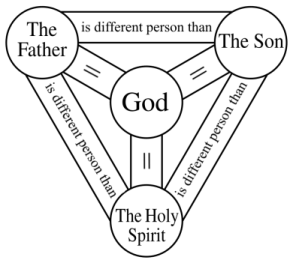
    I skipped this because this can seem to contradict the last part of the verse at first glance. I just wrote that Jesus was there in the beginning. I also said that God and the Word are interchangeable. Jesus is God. Yet, John 1:1 says that Jesus was WITH God. So somehow Jesus IS God but was also WITH God? How is that possible? With humans, you cannot say, “John is John and John is with John.” This is why the early Church came to understand that God exists as a Trinity. I will not list verses here, but there are many places where Jesus is clearly equated with God, the Father of the Old Testament is equated with God, and the Holy Spirit is equated with God. There can be no other explanation of God’s nature besides the Trinity. Somehow Jesus is God and yet was with God. This verse alone destroys all the trinitarian heresies (a heresy is a belief that excludes you from salvation) that have been invented through the ages. Let’s consider just two of them…

    1. Arianism

    Arianism was popularized by a man named Arius back in the 200’s-300’s AD. He essentially taught that Jesus was created. If Jesus was created, then we can’t say that Jesus IS God. When God creates something, there is always a distinction made between the creator and creation. Jesus would have to be something other than God. However, the verse clearly says that Jesus is God. There’s no way around this.

    1. Sabellianism

    Sabellianism is a lesser known heresy that was invented by a man named Sabellius in the 200’s AD. Sabellianism is also sometimes called modalism. This view states that God acts in 3 ways or modes. He acted as Father in the past, he then acted as Jesus for a time, and now acts as the Holy Spirit. The best illustration of this that has been given is comparing God to an actor who plays 3 different parts in a play. You can see this in movies like The Parent Trap or The Nutty Professor. In the Nutty Professor, Eddie Murphy plays several characters. He dresses up as the professor, his mother, grandfather and grandmother. Eddie Murphy is the actor, and he’s merely acting in different ways. Sabellianism denies the coexistence of three persons in the Trinity. However, John 1:1 says that Jesus was WITH God. There is a distinction of persons within God! God can’t be one person if Jesus is God and yet was with God!

    The correct way to understand the Trinity is that God is one being, or one essence, that exists in three persons. Each person of the Trinity is God. The Father is God, Jesus is God, and the Holy Spirit is God. However, Jesus is not the Father, Jesus is not the Holy Spirit, and the Holy Spirit is not the Father.  This took quite a long time in church history to express clearly. It is not easy to understand, but then again, it’s God we’re talking about.

    V2 – “He was in the beginning with God.”

    Verse 2 is a repeat of the middle phrase verse 1 (the Word was with God). However, “the Word” is replaced with “he” (houtos). Houtos in Greek can sometimes be translated as “this one”, but the context of the following verses makes “he” a better translation. So if a Greek reader was thinking of “the Word” as an impersonal force, John makes the Word personal. The Word is a person. The Word is the person John is writing about. The Word is Jesus.

    So why does this matter?

    I’ll stop with only 2 verses, but if you believe that Jesus is God then that changes everything. It means he was more than a smart man, or a prophet, or a nice guy who lived a long time ago. Jesus was the next step in God revealing his nature, his triune nature. It is in Jesus that we receive forgiveness of sins. It is in him that we are given life. It is because of God’s triune nature that God the Father was able to transfer our sins upon God the Son. Sabellianism threatens this transfer of sin for our freedom. Arianism (also Jehovah’s Witnesses and Mormons) threatens the atonement in that Jesus just becomes a regular guy who dies on a cross and couldn’t really accomplish anything. Jesus had to be God to never sin. If Jesus were anything less than God, then the cross doesn’t mean a thing. Maybe in another post I’ll go deep into the Trinity, but let it be enough for now with John 1:1-2 that Jesus is God, and that changes everything!