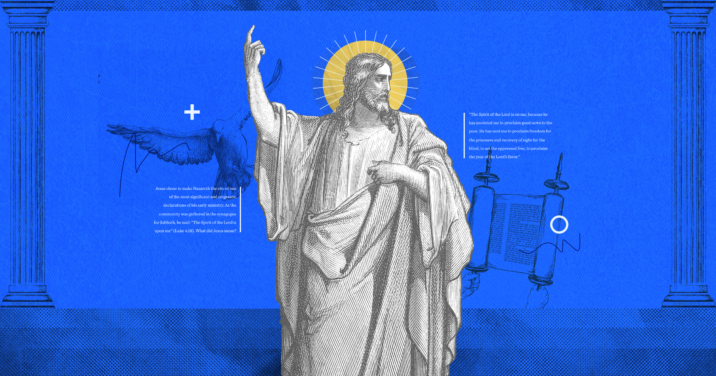
The fourth reason to believe the Bible is divine in origin is because Jesus himself believed in the authority of it. What is odd to me is that sometimes you meet a person who claims to love Jesus, and yet they pick and choose what parts of the Bible to accept or not. Jesus himself believed the entire Bible! Also, if you don’t take the Bible as a whole, why would you ever believe in Jesus’ claims since we learn of his divinity and salvation through the Bible?! If you reject certain parts of the Bible, who is to say that the parts written about Jesus are correct? What has happened is that such people pick and choose whatever parts they feel like accepting. The Word of God doesn’t work this way. It’s either all correct (inerrant) or it’s an untrustworthy book.
So how do I know that Jesus believed the Bible? We’ll consider a few examples. Let’s start with Matthew 19:3-8.
Some Pharisees came to him to test him. They asked, “Is it lawful for a man to divorce his wife for any and every reason?”4 “Haven’t you read,” he replied, “that at the beginning the Creator ‘made them male and female,’[a] 5 and said, ‘For this reason a man will leave his father and mother and be united to his wife, and the two will become one flesh’[b]? 6 So they are no longer two, but one flesh. Therefore what God has joined together, let no one separate.” 7 “Why then,” they asked, “did Moses command that a man give his wife a certificate of divorce and send her away?”8 Jesus replied, “Moses permitted you to divorce your wives because your hearts were hard. But it was not this way from the beginning. 9 I tell you that anyone who divorces his wife, except for sexual immorality, and marries another woman commits adultery.”
In its context, the Pharisees question Jesus regarding divorce. Jesus answers by quoting Genesis 2:24 in verse 5 as the basis for God’s view of marriage. Basically, Jesus settled this argument with the authority of the Old Testament. He does not go to traditions, cultural ideologies, or anything else. He simply relies on the Bible. In other words, Jesus himself believed in the authoritative nature of the Old Testament.
Let’s look at another example, Matthew 5:17-19.
“Do not think that I have come to abolish the Law or the Prophets; I have not come to abolish them but to fulfill them. 18 For truly I tell you, until heaven and earth disappear, not the smallest letter, not the least stroke of a pen, will by any means disappear from the Law until everything is accomplished. 19 Therefore anyone who sets aside one of the least of these commands and teaches others accordingly will be called least in the kingdom of heaven, but whoever practices and teaches these commands will be called great in the kingdom of heaven.
What is Jesus saying? He explains that the words of the Old Testament (the Word of God) are BINDING. What was written in the Old Testament WILL be accomplished! People will be held accountable for what was written. Jesus here affirms once again the abiding validity of the Word of God. He 100% agreed with the rest of Scripture.
We’ll consider yet another passage, John 16:12-15.
“I have much more to say to you, more than you can now bear. 13 But when he, the Spirit of truth, comes, he will guide you into all the truth. He will not speak on his own; he will speak only what he hears, and he will tell you what is yet to come. 14 He will glorify me because it is from me that he will receive what he will make known to you. 15 All that belongs to the Father is mine. That is why I said the Spirit will receive from me what he will make known to you.”
Here, Jesus is giving authority to the future teaching of the apostles, which is what we have in the New Testament. All the books of the New Testament were either written by an apostle or someone who was very close to the apostles (like Mark and Luke). JI Packer said something useful in regard to this passage, “He had promised the twelve that the Spirit should come to teach them what in His own earthly ministry he had left unsaid, and He kept His promise; so that the apostolic teaching was in reality the complete and final version of His own.”1 Not only did Jesus recognize the authority of the Old Testament, he also recognizes what the apostles write.
As our last example, we’ll consider Matthew 15:1-9.
“Then Pharisees and scribes came to Jesus from Jerusalem and said, 2 “Why do your disciples break the tradition of the elders? For they do not wash their hands when they eat.” 3 He answered them, “And why do you break the commandment of God for the sake of your tradition? 4 For God commanded, ‘Honor your father and your mother,’ and, ‘Whoever reviles father or mother must surely die.’ 5 But you say, ‘If anyone tells his father or his mother, “What you would have gained from me is given to God,”[a] 6 he need not honor his father.’ So for the sake of your tradition you have made void the word[b] of God. 7 You hypocrites! Well did Isaiah prophesy of you, when he said:
8 “‘This people honors me with their lips,
but their heart is far from me;
9 in vain do they worship me,
teaching as doctrines the commandments of men.’”
In this passage, Jesus rebukes the Pharisees for putting their own traditions and commands above God’s commands (the Word of God). It is very clear here that Jesus indicates that we understand that the words of the Bible come from God himself! The premise for his reasoning is that the Pharisees’ traditions are not coming from God himself, whereas the Bible is indeed from God. As can be seen from the 4 passages above, Jesus considers the Bible to be binding and authoritative. The reason for its authority is because the words come from God.
Unfortunately, there are many today that tend to exalt words spoken specifically by Jesus over the rest of the Bible. They treat his words as though they are somehow more significant than the rest of the word of God. However, the very nature of the Word of God goes against this thought pattern. The very nature of the Bible demands that ALL the words of the Bible have equal weight and authority. As West Oneonta Baptist Church’s statement of faith says, “What the Bible says, God says.”! Yes, we have the written words of Jesus (who is God), but the other words of the Bible were just as much from God as Jesus’ words were.
Where this trend of putting Jesus’ words above rest of the Bible is typically seen is in liberal “Christian” groups. They claim that sins such as homosexuality and abortion must not be sins since Jesus never said anything about it. This is a faulty argument because Jesus believed the rest of the Bible (which condemns homosexuality and murder), and he gave the apostles (and the apostles alone) authority to transmit God’s teachings in light of Jesus’ death and resurrection.
The point I’m making is that since Jesus himself believed in the inspiration and authority of the Bible, and we should likewise consider the Bible to be of divine origin. If you say you believe in Jesus, then you ought to take the whole Bible seriously since he did himself!
1 J.I. Packer, “Fundamentalism” And The Word Of God (Grand Rapids: Eerdmans, 1958), 64.





 Thinking Theo